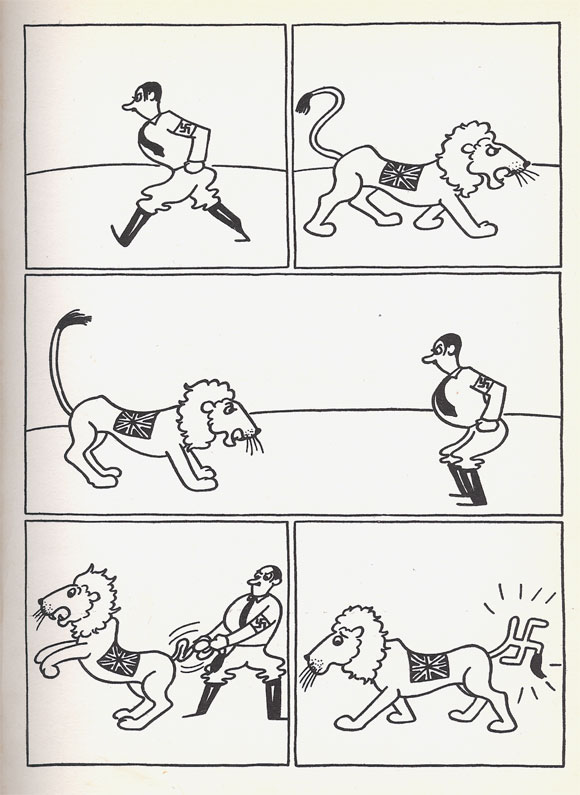
From Otto Soglow’s Confidential History of Modern England (1939)–another Kayo Books find.
Harry McCracken's website

From Otto Soglow’s Confidential History of Modern England (1939)–another Kayo Books find.
Normally, I think of this blog as a refuge from controversy, not a hotbed of it. But John J. Powers, author of the play about Walt Disney and Hitler I reviewed recently, has written to me and Mike Barrier to protest our posts about his work. (I first learned about the play over at Mike’s site; Mike has already commented on Mr. Powers’ communications.)
Mr. Powers disputes some of the things I said and asks, “Please, McCracken, do your research, and have the responsibility to correct yourself to those who would pay attention to your blog. ” Okay, I’ll try.
Mr. Powers on evidence that Disney met Hitler:
Firstly, the evidence for the meeting of Disney and Hitler is in the Disney
Archives and in the Volkische Beobachter, the German Nazi newspaper. The
Archives point out that Munich newspapers, in the summer of 1935, welcomed
Disney (with headlines, no less) as “the great white hope against the Jews
of Hollywood.” Disney’s anti-Semitism and anti-unionism were well known in
Hollywood, and Leni Riefenstahl came to Hollywood in 1938 and was wined and
dined by Disney while all other studio heads boycotted her. For
information on Disney’s anti-Semitism, please read DISNEY’S WORLD by
Leonard Mosley or WALT DISNEY: HOLLYWOOD’S DARK PRINCE by Marc Elliot, or
again, WALT DISNEY: THE TRIUMPH OF THE AMERICAN IMAGINATION by Neal
Gabler.
Mike has responded to the above better than I ever could; Mr. Powers hasn’t, of course, provided proof of a Disney-Hitler meeting. If he has any specific evidence that one took place, I think that every Disney historian worth his or her salt would love to hear about it.
Mr. Powers also says “There was no bar code on the book onstage (you have a vivid imagination).” There were several books onstage; sitting in the audience, I thought I saw a bar code on one, in a stack under a table. After the play ended, I walked over to look more closely–and it sure looked like a bar code to me.
Mr. Powers: “Incidentally, the Grimm tale “The Jew in the Thornbush” (not AND the Thornbush) is contained in the original complete Grimm tales (not the abridged collection most Americans know).” Point taken: I misheard the name of the tale.
When I responded to Mr. Powers and expressed my distaste for Marc Eliot’s Walt Disney: Hollywood’s Dark Prince and Leonard Mosley’s Disney’s World–which, as Mike said, are the worst Disney biographies ever written– and said the latter was riddled with basic errors, he responded, in part, “No one but you seems to be suggesting Mosley’s factual errors. If you could bother to cite them and back up what you say that would be different.”
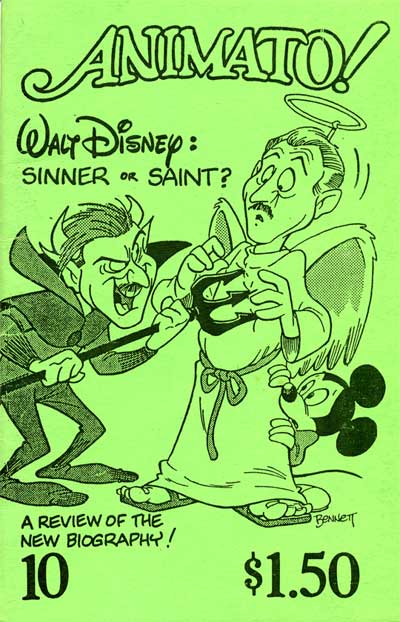
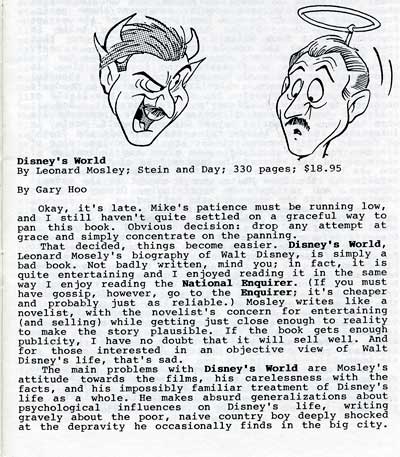
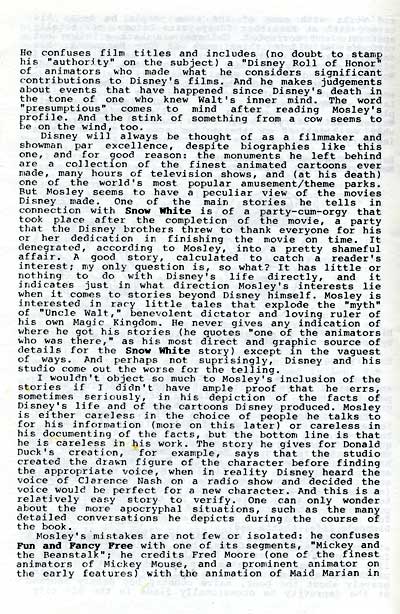
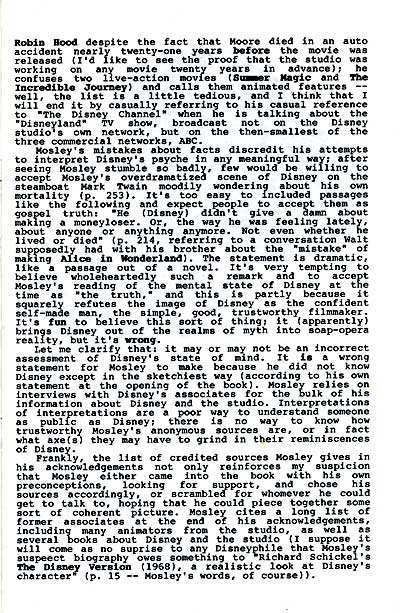
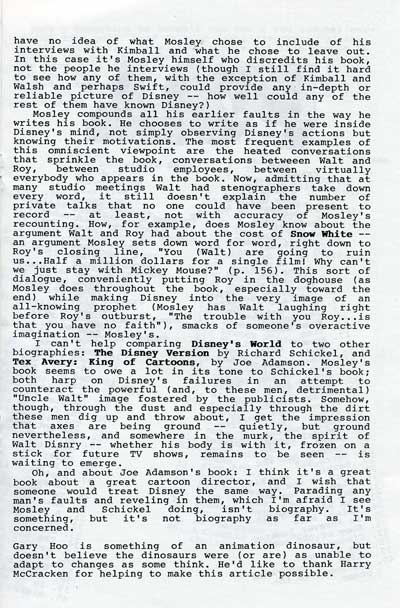
Lemme try to cite some errors, which I’ll do by reprinting the cover story we published in Animato #10 (Summer 1986) in its entirety below. As for backing up the contention that Mosley made mistakes, anyone out there want to confirm that the mistakes Gary Hoo mentions are indeed mistakes? Alternatively, anyone want to argue, for instance, that Fred Moore did work on Snow White, or that Summer Magic and The Incredible Journey are cartoons? (Side note: When Mosley’s book was published, Dave Smith of the Disney Archives sent me a very, very long list of the mistakes it contained.)
|
SPOILER ALERT! If you plan on seeing Disney in Deutschland at San Francisco’s Next Stage Theater–or simply have a weak stomach–read no further…
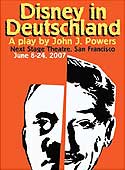
I’m just a slave to temptation: After reading about John J. Powers’ play at MichaelBarrier.com, I spent my Saturday night sitting through it. (The theater, incidentally, is in a church about a mile and a half from my house; I’m used to the fact that when bizarre things involving animation happen, they usually happen in close proximity to me.)
As Mike pointed out, there’s no evidence whatsoever that Disney ever met the Fuehrer. You wouldn’t know that from the materials handed out at the performance, though. Actually, they suggest the opposite, without ever quite definitively stating that the meeting is known to have happened: “Goebbels may have insisted that Hitler meet with Disney, the latter being the only contact with the major center of motion picture distribution at that time (Hollywood).”
And inevitably, they knowingly discuss Walt’s legendary anti-Semitism: “Mr. Disney…thought of himself as a bulwark against the Jews who controlled many of the major studios.” (You know you’re in trouble when the handout at a theatrical performance involving Walt Disney cites Leonard Mosley and Marc Eliot’s Disney biographies.)
The piece takes place in 1935 at Hitler’s Berchtesgaden mountain home, with a set that sports such authentic decorations as a “gramophone” with an LCD display and a book with a bar code on the jacket. Hitler (John Strain) is there with Leni Riefenstahl (Donna K. Moore)–they can’t keep their hands off each other, which, as far as I know, is an alternate-reality touch in itself–and they’re anticipating Disney’s visit.
They’re quite excited about it: “Disney’s our mensch!,” burbles Adolf. Leni, however, does point out that “his films were banned here for years because some animal–a duck, I think–ridiculed the Kaiser.”
Walt arrives; as played by Brendan Scoggin, he looks and behaves more like Hal “The Great Gildersleeve” Peary than the Disney we know. “Goebbels tells me that you make pictures for children,” comments Hitler by way of conversation.
“Herr Hitler, I don’t know if you know this, but you have quite a following in America,” says Walt genially, mentioning that he’s attended Nazi rallies in Los Angeles. He spews hatred at Hollywood rivals like “that damned Jew at Universal.” And boasts that he manages to avoid interaction with the Jews because “we create, produce, and distribute–we do everything ourselves!” (Apparently, Buena Vista existed in 1935; we just didn’t know it.)
Suddenly inspired to play storyman, Adolf attempts to convince Walt to make a cartoon based on a Brothers Grimm tale called “The Jew and the Thornbush,” but Walt seems skeptical of its potential. Even so, they’re kindred spirits, and Walt recognizes it: “Herr Hitler, we’re doing the same thing, but in different ways.”
And then they really bond when Walt confides in Adolf that he remains tormented by how Elias stripped him naked and beat him as a child; a compassionate Adolf tells Walt that his father loved him even so.
All along, both Walt and Adolf have been admiring a large scale model of Germania, Hitler’s planned renewal project for Berlin. Walt loves it, seeing it as a place with interesting buildings, attractions, and things for families to do together. You almost expect him to start talking about E tickets and churros.
Finally, Walt gets to the point of his visit: He wants Adolf to allow the distribution of Disney cartoons in Germany. Adolf agrees, on one condition: that if anything happens to him, Walt will see to it that Germania is built in some form or fashion. We see an image of Germany’s fairytale-like Neuschwanstein castle, famous for inspiring the Disneyland castle, projected behind them as “It’s a Small World” begins to play. The performance ends.
(OK, I made up the part about “It’s a Small World.” But only that part.)
I may sound lighthearted, but it’s all an act–I’m appalled. Depressed, even.
Nowhere in the handouts I received does playwright/director Powers say that his work is even slightly speculative. A couple of dozen well-meaning San Franciscans attended the performance I saw; I may well have been the only one who left the theater not believing that it’s historical fact that Walt Disney was a vicious anti-Semite who met Hitler and got along famously with him. And dozens more will see the play before it closes, at least some of who will presumably spread the word about Walt’s hatred and Adolf Hitler’s little-known involvement in the creation of Disneyland.
I’m beginning to feel a little queasy just thinking about all this. So let’s end with a cartoon which, when it was released in 1942, must have disappointed Walt’s buddy the Fuehrer no end….
I’m kind of ashamed to admit this, but after learning from Mike Barrier of a play here in San Francisco involving Walt Disney meeting Hitler–Mike, incidentally, has been blogging up a storm recently–I’m going to go see it tomorrow evening.
If nothing else, I figure that by buying a seat, I’m potentially denying one Disney-hater the opportunity to see the show. Watch this space…
